
27 August 2026
Productivity key to unlocking Australia's potential
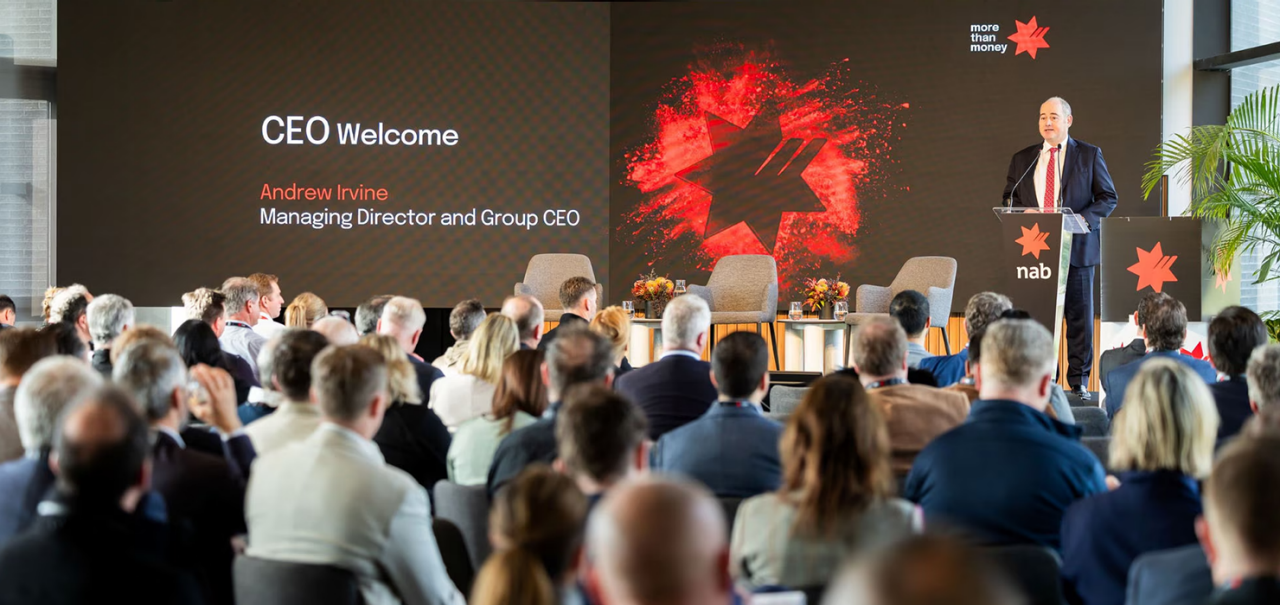
NAB Group CEO Andrew Irvine says Australia has the foundations to thrive, but realising its potential will require a renewed focus on productivity, investment and long-term economic reform.
Speaking at the 2026 NAB Business Summit, Mr Irvine said Australia should be optimistic about the longer term: “We have the resources the world needs, abundant energy, strong institutions, world-class businesses and talented people. And we have enormous opportunities to drive growth in energy, agriculture, infrastructure, technology and housing. The ingredients are there,” he said
However, he said the country was at risk of getting stuck in a low-growth trap: “Without urgent action, we’ll be locked in a slow lane - sitting in the rear-view mirror as other advanced economies surge past us,” said Mr Irvine
Areas needing attention include declining productivity, housing supply, energy costs, tax settings and red tape. At the top of the list is productivity, as it is the engine that powers higher living standards. Without it, wages stagnate, economic growth slows and governments have fewer resources to invest in public services and infrastructure.
Australia’s productivity performance has steadily deteriorated over several decades. Labour productivity growth averaged around 2.25 per cent annually in the decade to 2005, fell to about 1.5 per cent in the decade to 2015 and then slowed to 1.1 per cent in the decade to 2020, making it the weakest productivity decade in 60 years. The gap between Australia and leading economies is widening, with US productivity growth running at around twice Australia's pace and Singapore's more than three times higher.
Mr Irvine said future prosperity depends on reforms that encourage investment, entrepreneurship and risk-taking, while housing supply, affordable energy, more efficient tax settings and reducing regulatory complexity were all identified as areas requiring greater urgency.
He also said productivity cannot be left to governments alone: “Business, regulators and unions all have a role to play if Australia is to avoid becoming trapped in a cycle of low growth and declining competitiveness,” he said
Mr Irvine’s comments came as businesses contend with geopolitical uncertainty, persistent inflation, higher interest rates and a broadening housing market adjustment. Mr Irvine said business conditions remained mixed, with mining, agriculture and wholesale trade showing resilience, while manufacturing and mid-market retail remain under pressure.
Another issue discussed throughout the Summit was artificial intelligence (AI).
Rather than framing AI as just another technology trend, Mr Irvine described it as the fourth industrial revolution, placing it alongside the steam engine, electricity and the computer in terms of its potential impact on society and business. The promise of AI, in his view, was its ability to remove friction from work, compress complexity and help organisations achieve outcomes at extraordinary speed.
That does not mean AI will automatically deliver productivity gains. He said AI was an amplifier rather than a silver bullet: “In organisations with strong cultures, effective governance and clear processes, AI can accelerate innovation, improve productivity and strengthen competitive advantage. In weaker organisations, it can magnify inefficiencies and deepen existing problems. The technology itself is not the differentiator. How businesses deploy it will determine whether it becomes a growth engine or another missed opportunity,” Mr Irvine said.
Mr Irvine’s focus was on practical adoption rather than abstract possibilities. He highlighted the example of a small manufacturer using AI to draft emails, summarise meetings, prepare proposals and improve quoting processes.
“These are not futuristic use cases, he said. “They are everyday applications that save time and allow business owners to focus on customers, growth and strategic decisions. It is this kind of widespread adoption, rather than a handful of breakthrough innovations, that could have the greatest impact on national productivity.”
Mr Irvine also rejected the notion that AI should primarily be viewed through the lens of job losses. While acknowledging that some roles will disappear and others will change, he argued that history shows technology creates new opportunities alongside disruption. “The challenge is ensuring Australians develop the skills needed to work alongside AI rather than compete against it. Human judgement, empathy, communication and trust-building will become more valuable, not less, in an AI-enabled economy,” he said.
Mr Irvine’s speech was both a warning and a call to action. Australia’s challenge is not a lack of resources, talent or opportunity. It is a lack of urgency. The country has the ingredients required for long-term success, but unlocking that potential will require faster productivity growth, greater investment, regulatory reform and a willingness to embrace technological change. If Australia can meet those challenges, AI could become a catalyst for renewal. If it cannot, the nation risks watching more ambitious economies leave it behind.