
Monday 22 June
Business Pulse: July 2026
By Shane Ditcham

AI can feel like a big leap. New tools are arriving quickly, the risks are real and knowing where to start isn’t always easy.
But from where I sit, small and medium businesses may have the advantage. They tend to be more nimble, closer to their customers and able to make decisions without the layers of complexity that can slow larger organisations down. That’s a boon in the era of AI.
It’s not about rushing in. You don’t have to be first off the block. But you do have to be ready to move when the opportunity is right. For businesses that are hesitant to roll out AI at scale, now is a good time to be learning, experimenting and building confidence.
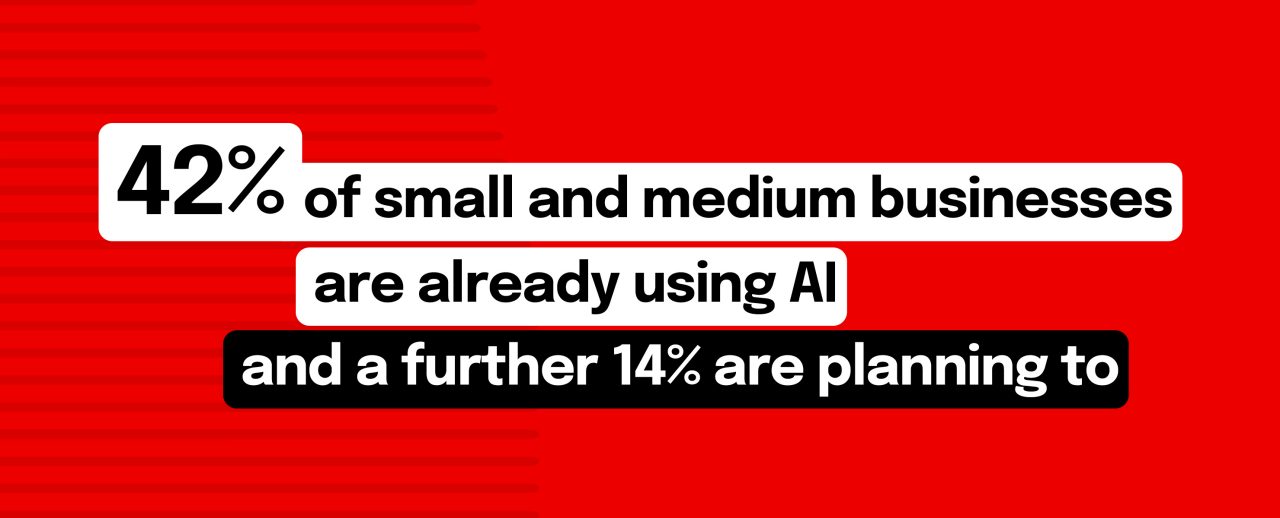
The reality is that adoption is already well underway. New NAB Economics data shows more than four in 10 Australian small and medium businesses (42%) are using AI tools and another 14% planning to adopt them. What we’re seeing is a shift from experimentation to practical application, as businesses look for ways to improve efficiency, drive growth and, in some cases, create entirely new ways of operating.
What's particularly interesting is where businesses are finding value.
Those leading the way tend to operate in industries that handle large volumes of data, including Property Services (69%), Finance and Insurance Services (64%) and Business Services (61%). They are often digitally mature, comfortable with integrating new technology, and well placed to benefit from the productivity gains on offer from automating specific tasks and workflows.
In fact, automation is a drawcard for many businesses with NAB research finding that 35% see this as the biggest opportunity for AI.
Others, meanwhile, are focused on customer-facing operations with almost a third (31%) putting marketing and sales as their top priority. When done well, this can make things easier for both the business and the customer. From personalised marketplace recommendations to AI-powered customer service agents, there are already practical, off-the-shelf options ready to go.
In my experience, the businesses getting the most from AI aren't necessarily the ones spending the most money. They're the ones that stay focused on the customer and start with what customers actually need.
That's where smaller businesses can benefit again. Their close relationships with customers, suppliers and partners often make it easier to identify opportunities, test ideas and adapt.
We're already seeing that among NAB customers. Some are using AI to predict maintenance issues before they occur, reducing downtime and costly disruptions. Others are optimising delivery routes, lowering fuel costs and improving operational efficiency.
Getting started
Although 44% of businesses report they aren’t using AI, almost every internet-enabled workplace will have some exposure through everyday tasks like internet searches or drafting emails, so it pays to understand what’s happening around you rather than wait for a big bang before making a move.
That’s why it’s important to research what tools are available and how they might be able to help. Even something as simple as a subscription to multiple major LLMs can help a business keep on top of the rapidly changing capabilities of AI tools.
Many of these suppliers offer training in their products and in the general use of AI, which you can access via our AI tools for small business webpage. It includes free foundational courses from the CSIRO’s National AI Centre, helping business owners and employees gain the knowledge and confidence to get started.
Testing a practical application of AI can be done in partnership with a particular vendor or customer, with a small-scale pilot over a specified period and focusing on a single use case.
Putting it into action
Once a use case has proven its value and return, it can be scaled with the right investment. Already, 10% of business investment is going towards software. That means it’s particularly important to get the decision right when purchasing or leasing. You don’t have to go with the most expensive option though. The fact is AI pricing models might not always fit in neatly with your existing cost structure and cashflow but many lower-cost tools can be manageable for smaller businesses.
Security is another area that deserves attention. Data leakage, hallucinations, and employees using unapproved tools have already tripped up Australian businesses. It’s all the more reason to educate your employees and understand the tools out there that can protect your business.
As ever, it pays to invest in people. As AI becomes part of how we live and work, human skills like judgment, trust and relationships will matter more than ever. Helping employees to adapt will empower them to help your business adapt.
Meanwhile, Jobs and Skills Australia has found that almost 90% of jobs have medium to high exposure to augmentation; these roles can expect some degree of change. Rather than replacing staff, that’s an opportunity for greater productivity and growth for those employees and businesses which are prepared.