
NAB Private Wealth and JBWere Chief Investment Officer, Alexandra Campbell, examines the pace of economic change from a global and domestic perspective and where to focus your attention.

Investments
03 November 2026
How do capital raisings compare with other investment options?
Capital raisings can give investors access to new shares, bonds and hybrids directly from the companies issuing them. Understanding how they compare with the investments you may already hold, and the role they can play in a portfolio, can help you decide whether they're worth a closer look.
By Damon Frith, Wealth Editor, NAB Private Wealth
Key takeaways
- Capital raisings sit between cash, listed shares and managed funds: they generally offer more return potential than cash, but more concentrated risk than a diversified fund.
- Compared with buying on the share market, the main differences are the terms: a set price, a limited offer period and the possibility of receiving fewer securities than you applied for.
- Capital raisings aren't a separate type of investment. They're a way into shares, bonds and other investments that can fill different roles in a portfolio.
- How a capital raising fits depends on what you're buying and what you need your portfolio to do.
How do capital raisings compare with other investments?
Most investors are familiar with cash, shares bought on the share market and managed funds. Capital raisings share some features with each, but differ in return potential, risk, flexibility and diversification. The table below sets out the key differences. For more detail on how each type of raising works, see our companion article on the different types of capital raisings.
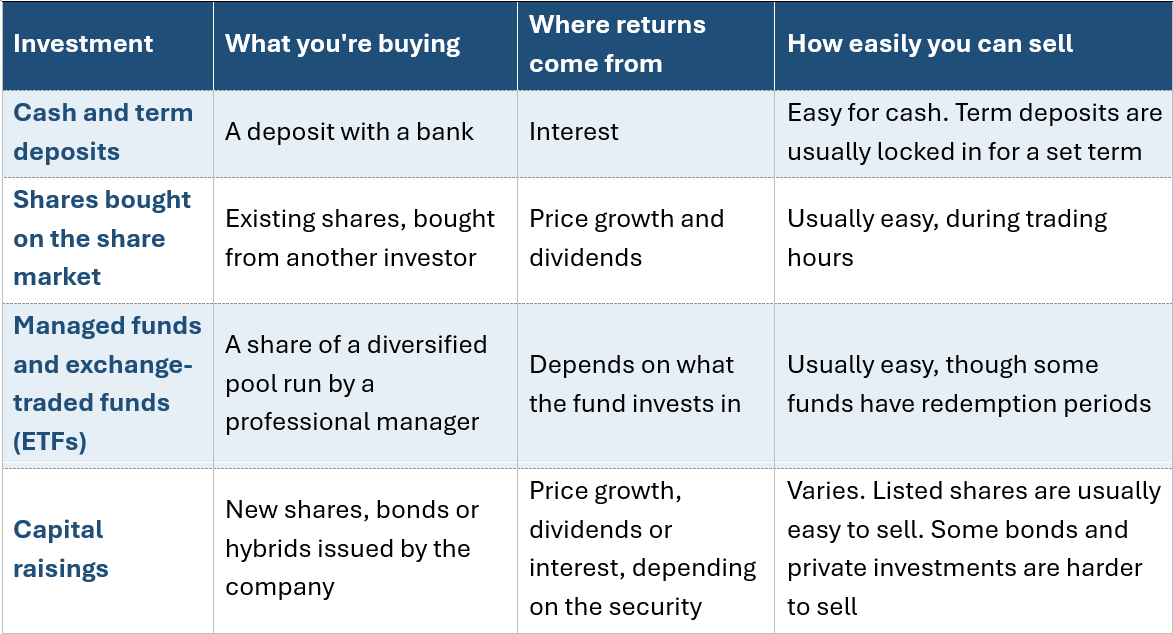
Compared with cash, a capital raising usually offers the potential for higher returns, but with more risk. Bank deposits are covered by the Australian Government's Financial Claims Scheme up to $250,000 per account holder per bank. Shares and bonds have no such protection.
Compared with buying shares on the share market, you get exposure to the same kind of company but on different terms. The price is set for the offer, and for listed companies it is often below the recent market price. The offer is open for a limited time, and if demand is strong you may receive fewer securities than you applied for.
Compared with managed funds, a capital raising is a more targeted choice. Instead of spreading your money across many companies, you're investing in one company you've chosen, which means more control but less diversification.
In short, a capital raising doesn't replace any of these investments. It offers a different way in, with its own trade-offs between price, timing, control and diversification.
Where do capital raisings fit in a portfolio?
It can help to think of a portfolio as a set of building blocks, each with a job to do. Capital raisings aren't a separate block. They're a way to add to the blocks you already have.
Growth: share offers and IPOs
This part of a portfolio aims to increase in value over time and usually includes shares. Share offers from companies, such as initial public offerings (IPOs), placements and offers to existing shareholders, generally sit here. They can let you buy into a newly listed company or add to a company you already own.
Income: new corporate bond issues
This part aims to provide regular, more predictable payments. New corporate bond issues generally sit here, alongside cash and term deposits, and can offer a fixed or floating rate of interest for a set term. The trade-off is that payments depend on the company's ability to pay.
In between: hybrid securities
Hybrid securities pay regular income, much like a bond, but can behave more like shares when markets are under stress. They need careful consideration and are better suited to investors who understand how they work.
Longer term: private market raisings
Some capital raisings, particularly in private markets, are designed to be held for several years and may be difficult to sell before then. These are generally suited to money you won't need in the short term.
Many investors build a diversified core, often through managed funds, ETFs or a broad mix of shares and bonds, and then add individual opportunities around it. Capital raisings can play that role. They let you act on a particular company or income opportunity without changing the overall shape of your portfolio. Keeping each position in proportion can help avoid relying too heavily on a single company, industry or type of risk.
Before taking part in an offer, it can help to ask three questions. What job will this investment do in my portfolio: growth, income or something in between? How much of my portfolio should it represent? And how long am I prepared to hold it? The answers can help you judge whether an opportunity fits your plan, rather than simply whether it looks attractive on its own.
What should you keep in mind before investing in a capital raising?
Each capital raising comes with an offer document setting out how the money will be used, the terms of the offer and the main risks. It's the best starting point for understanding any opportunity. It's also worth considering whether a new share issue will reduce your share of the company if you don't take part, and how easily you could sell the investment if your circumstances change.
Frequently asked questions
Are capital raisings riskier than cash?
Generally, yes. A capital raising usually offers the potential for higher returns than cash, but with more risk. Bank deposits are covered by the Australian Government's Financial Claims Scheme up to $250,000 per account holder per bank, while shares and bonds have no such protection.
How is a capital raising different from buying shares on the share market?
You get exposure to the same kind of company, but on different terms. The price is set for the offer and, for listed companies, is often below the recent market price. The offer is open for a limited time, and if demand is strong you may receive fewer securities than you applied for.
Can a capital raising replace a managed fund or ETF?
Not usually. A managed fund or ETF spreads your money across many companies, while a capital raising is a targeted investment in one company. Many investors keep a diversified core, often through managed funds, ETFs or a broad mix of shares and bonds, and add individual opportunities such as capital raisings around it.
Which part of a portfolio does a capital raising belong in?
It depends on what you're buying. Share offers, including IPOs and placements, generally sit in the growth part of a portfolio. New corporate bond issues generally sit in the income part. Hybrid securities sit in between, and private market raisings are generally suited to money you won't need in the short term.
What should I read before taking part in a capital raising?
Start with the offer document. It sets out how the money will be used, the terms of the offer and the main risks.
Explore more
A closer look at IPOs, rights issues, placements, private equity, bonds and hybrids, and how public and private raisings differ: Read more exploring different types of capital raisings
How NAB Private Wealth can help
NAB Private Wealth provides market insights, investment information and execution support to investors across a range of primary market opportunities, including capital raisings, IPOs and bond issuance.
Capital raisings through NAB Private Wealth are only available to eligible wholesale investors, with a minimum investment of $50,000 or more depending on the offer.
Speak with a NAB Private Wealth Investment Specialist to discuss upcoming capital raising opportunities, wholesale investor eligibility and how primary market investments may complement your portfolio. Call 02 7226 7157 or email investordesk@nab.com.au.
The information contained in this article is believed to be reliable as at November 2026 and is intended to be of a general nature only. It has been prepared without taking into account any person's objectives, financial situation or needs. Before acting on this information, NAB recommends that you consider whether it is appropriate for your circumstances. NAB recommends that you seek independent legal, property, financial and taxation advice before acting on any information in this article.
© 2026 NAB Private Wealth is a division of National Australia Bank Limited ABN 12 004 044 937 AFSL and Australian Credit Licence 230686.
Investments

Dissecting the shopping basket that shapes interest rates
Article
Understanding the consumer price index (CPI) and how its formulated helps to form a cohesive economic picture, and it is also helps when forming an investment strategy.