
The rise of AI has risks portfolio concentration in a small number of technology companies. Is that a problem?

First published May 2025
Updated September 2026
What is stagflation? Causes, risks and investment implications
Stagflation is a term that has been increasingly discussed in the business media as a risk for the US economy and the global economy more broadly. So - what is stagflation, and why is it so bad?
By Derek Bilney, Senior Investment Specialist, NAB Private Wealth
Stagflation is one of the most difficult economic environments for governments, central banks, businesses and investors. It occurs when inflation remains high while economic growth slows and unemployment rises. Because the usual policy tools used to fight inflation or stimulate growth can worsen one side of the problem, stagflation presents a unique challenge. This article explains what stagflation is, what causes it, how it affected markets during the 1970s, and what investors should consider if stagflation risks re-emerge.
Stagflation is rare but impactful. The most notable instance occurred in the 1970s, triggered by the 1973 oil crisis, which disrupted global supply chains, spiked prices, and slowed growth. Some economists have identified potential stagflation-like conditions present in Australia in recent years. For example, inflation exceeding the Reserve Bank of Australia’s 2–3% target (peaking at 7.8% in 2022) and negative per-capita GDP growth for seven consecutive quarters, (from March 2023 to September 2024) marking the longest period of consecutive declines in per-capita GDP since records began.
However, low unemployment (currently around 3.5–4%) is missing in the stagflation equation, just as high interest rates were the missing element in the 1990-91 recession. Post-COVID-19, stagflation concerns resurfaced as supply chain bottlenecks and labour shortages drove inflation, while growth lagged in some sectors. Though less severe than the 1970s, these conditions echoed earlier supply-driven pressures, underscoring stagflation’s relevance today.
What is stagflation?
In a typical economic cycle, strong growth spurs demand, pushing prices higher. Central banks respond by raising interest rates to cool demand, slowing growth and inflation. Once inflation stabilises, rate cuts encourage growth and employment, restarting the cycle.
Stagflation disrupts this pattern. With weak growth and high inflation coexisting, central banks face a dilemma: raising rates to tame inflation risks further stunting growth, while cutting rates could worsen price pressures. Fiscal stimulus, intended to boost growth, may also fuel inflation. The Phillips Curve, which expects an inverse relationship between inflation and unemployment, fails to explain stagflation, as both inflation and unemployment can rise simultaneously due to supply shocks. In the 1970s, the U.S. Federal Reserve prioritised inflation control, but balancing growth and price stability required nuanced strategies, a challenge echoed in recent debates.
Why is stagflation difficult to manage?
Supply shocks are the primary drivers of stagflation. Sharp increases in oil prices, as seen in 1973, or resource shortages raise production costs, reduce output, and dampen demand. Tariffs act as supply shocks by increasing costs for consumers and disrupting trade, with reciprocal tariffs further harming exports and growth. The 1973 oil embargo, for instance, quadrupled oil prices, which contributed to the destabilisation of global economies.
Demand-side factors may also amplify stagflation. Wage-price spirals, where workers demand higher wages to offset rising costs, and excessive monetary stimulus can sustain inflationary pressures. Post-COVID-19, loose monetary policies in 2020–21, combined with supply chain disruptions contributed to inflation spikes, illustrating the interplay between wage-price spirals and excessive monetary stimulus.
.Stagflation’s persistence stems from the lack of straightforward solutions, making it typically harder to resolve than typical recessions.
What causes stagflation?
Combating stagflation demands a multi-faceted approach. For example, in the 1980s, US Federal Reserve Chairman Paul Volcker raised interest rates to 20% in 1980–81, paired with supply-side reforms like deregulation and tax cuts under President Reagan. These measures curbed inflation but caused a deep recession. High debt levels today—global debt-to-GDP at 256% in 2024—make such aggressive rate hikes difficult, though not impossible.
More feasible strategies to address stagflation include:
- Supply-side reforms, such as deregulation to boost productivity, tax incentives for innovation, or targeted immigration to address skill shortages.
- Operational efficiencies, like process automation or adopting cost-effective energy sources.
- Dynamic pricing and cost optimisation to align with market demand and protect margins.
- Easing supply chain pressures through open global trade, such as reducing tariffs.
- Global coordination, like G7 efforts in the 1980s to stabilise trade and currencies, can also mitigate supply shocks.
How did the 1970s stagflation crisis affect markets?
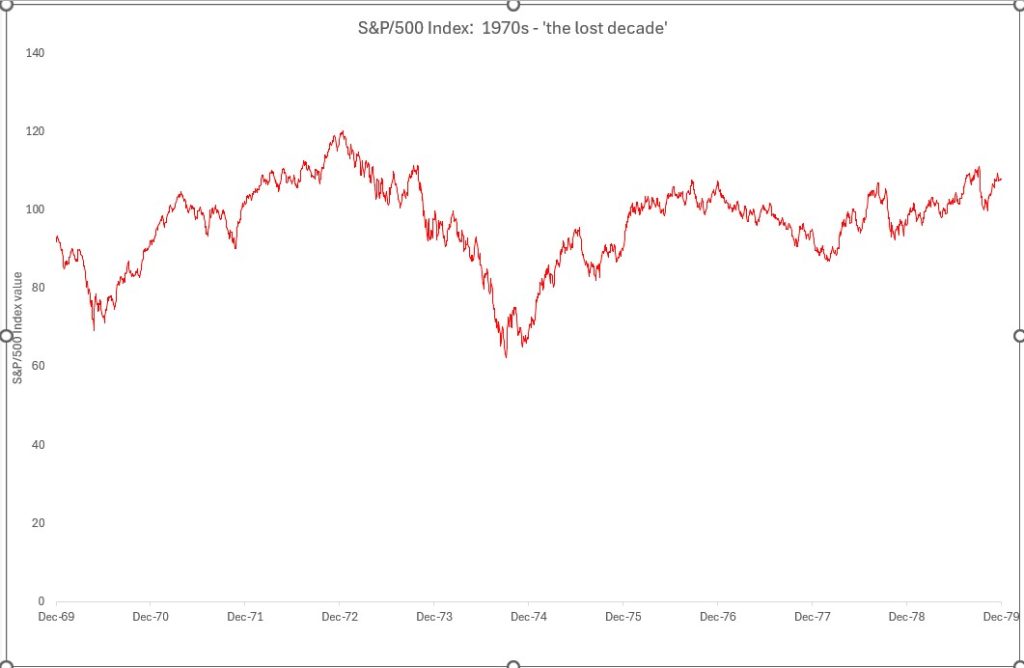
The 1970s was a “lost decade” for equities. The US S&P 500 traded between 90 and 110 points for much of the period, delivering a nominal return of 17% over 10 years (1.6% annualised, pre-dividends). Inflation, peaking at 13.5% in 1980, eroded real returns, with the S&P 500 losing nearly 50% of its inflation-adjusted value. As of April 2025, the S&P 500 stands at approximately 5,800, highlighting the era’s stark contrast.
Gold and oil outperformed, with gold soaring from $35 per ounce in 1970 to $850 by 1980, a 2,400% nominal gain, due to its role as an inflation hedge. Commodities and inflation-linked bonds also held value. Stagflation hurt equities through higher input costs (materials, labour, debt servicing) and reduced demand from unemployment. High interest rates lowered the value of future cash flows, compressing valuations. Typically, defensive, high-quality companies in essential sectors like utilities or healthcare fare better in such conditions, while growth-oriented or highly leveraged firms may struggle.
What does stagflation mean for investors?
Stagflation can create challenges for traditional portfolios because both economic growth and company earnings may come under pressure while inflation erodes purchasing power. Historically, some defensive sectors such as healthcare, utilities and consumer staples have proved more resilient than highly leveraged or growth-oriented companies. Real assets, commodities, infrastructure and inflation-linked securities may also help protect purchasing power during periods of persistent inflation, although performance can vary depending on the economic environment.
Conclusion
Stagflation remains one of the most challenging economic environments because it combines weak growth with persistent inflation, leaving policymakers with difficult trade-offs and investors facing pressure on both economic activity and asset prices. While the severe stagflation of the 1970s remains the most prominent example, recent episodes have demonstrated that supply shocks, geopolitical tensions and energy market disruptions can still create stagflationary pressures. Although inflation has moderated from its post-pandemic peaks, investors should remain mindful of the conditions that can give rise to stagflation and consider how their portfolios are positioned across different economic scenarios. A diversified portfolio, combined with a long-term investment approach, can help investors navigate periods of uncertainty should stagflation risks re-emerge.
Frequently Asked Questions
What is stagflation?
Stagflation is an economic environment characterised by weak or negative economic growth, high inflation and rising unemployment occurring at the same time. It is considered unusual because inflation typically falls when economic growth slows.
What causes stagflation?
Stagflation is most commonly caused by supply shocks that increase production costs while reducing economic output. Examples include oil price spikes, supply chain disruptions, labour shortages or trade barriers. Excessive monetary stimulus and wage-price spirals can also contribute to persistent inflationary pressures.
Why is stagflation difficult for policymakers?
Stagflation creates a policy dilemma because the tools used to fight inflation can weaken economic growth, while measures designed to stimulate growth can increase inflation. This makes it more difficult for central banks and governments to restore economic stability.
How does stagflation affect share markets?
Stagflation can be challenging for share markets because companies often face rising costs, weaker consumer demand and higher borrowing expenses. These conditions can reduce corporate profits and place pressure on company valuations.
Which investments have historically performed better during stagflation?
Historically, assets such as commodities, gold and some inflation-linked securities have performed relatively well during periods of stagflation. Defensive sectors, including healthcare and utilities, have also tended to be more resilient than highly leveraged or growth-oriented companies, although past performance is not a guarantee of future returns.
Has Australia experienced stagflation?
Australia has experienced some stagflation-like conditions at various times, including periods of elevated inflation and weak per-capita economic growth. However, unemployment has remained relatively low in recent years, meaning Australia has not fully met the traditional definition of stagflation.
Is stagflation a risk for investors today?
While inflation has moderated from its post-pandemic peaks, supply chain disruptions, geopolitical tensions, energy market volatility and trade restrictions remain potential sources of stagflationary pressure. Investors should remain aware of these risks and consider how their portfolios may perform under different economic scenarios.
How can investors prepare for stagflation?
A diversified portfolio that includes exposure to different asset classes, sectors and regions can help improve resilience during uncertain economic periods. Maintaining a long-term investment approach and avoiding concentrated exposures may help investors navigate the challenges associated with stagflation.
To discover more call 1300 683 106 or email us on investordesk@nab.com.au
View all Investment Insights and Articles
The information contained in this article is believed to be reliable as at September 2026 and is intended to be of a general nature only. It has been prepared without taking into account any person’s objectives, financial situation or needs. Before acting on this information, NAB recommends that you consider whether it is appropriate for your circumstances. NAB recommends that you seek independent legal, property, financial and taxation advice before acting on any information in this article.
©2026 NAB Private Wealth is a division of National Australia Bank Limited ABN 12 004 044 937 AFSL and Australian Credit Licence 230686.

Inflation and its impact on the economy and supply chains
ARTICLE
Beyond rising prices there is a broader story about how inflation occurs and its impact. We delve into the issue.
The information contained in this article is intended to be of a general nature only. It has been prepared without taking into account any person’s objectives, financial situation or needs. NAB does not guarantee the accuracy or reliability of any information in this article which is stated or provided by a third party. Before acting on this information, NAB recommends that you consider whether it is appropriate for your circumstances. NAB recommends that you seek independent legal, property, financial and taxation advice before acting on any information in this article. You may be exposed to investment risk, including loss of income and principal invested.
You should consider the relevant Product Disclosure Statement (PDS), Information Memorandum (IM) or other disclosure document and Financial Services Guide (available on request) before deciding whether to acquire, or to continue to hold, any of our products.
All information in this article is intended to be accessed by the following persons ‘Wholesale Clients’ as defined by the Corporations Act. This article should not be construed as a recommendation to acquire or dispose of any investments.