February 27, 2026
International Women’s Day 2026: Balancing the scales
More than one in three women-owned and led businesses (38%) cite access to finance as one of their top-three barriers, according to a 2025 ASBFEO survey.
It’s a stark reminder that, despite strong growth in female entrepreneurship, significant obstacles remain. This International Women’s Day, UN Women Australia is calling on us to ‘balance the scales together’ – a call that directly speaks to barriers like access to finance and the need to remove them so women (and girls) can fully shape their own lives and futures.
With that in mind, we asked our NAB senior bankers and women-led business owners what can make a real difference when it comes to accessing finance – whether you’re starting out or planning your next phase of growth.

Karen Brown, Owner, TerryWhite Chemmart Arana Hills, Ferny Grove and Ferny Central
Former professional netballer and entrepreneur, Karen Brown has gone far in pursuing her passions – in sport but also in business. A successful pharmacy owner since 2007, she has also launched one of Australia’s first dedicated sports pharmacy enterprises. What has helped her access the capital to pursue her dreams?
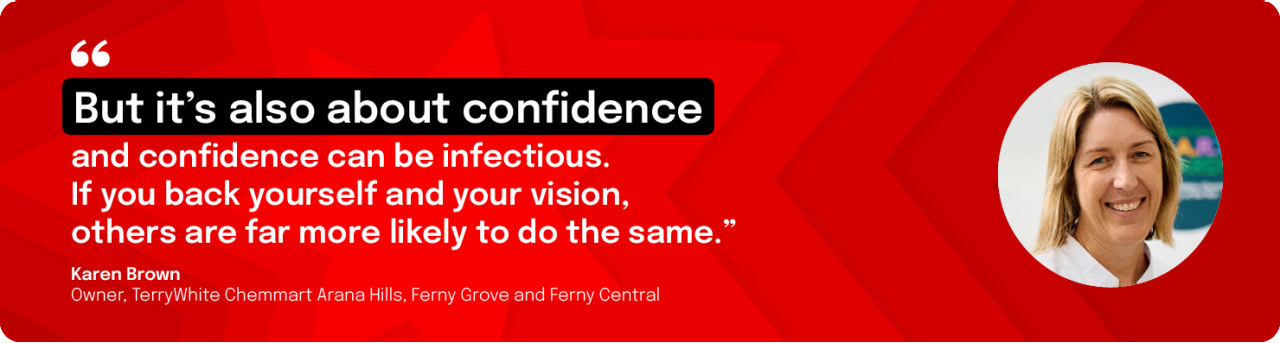
“It helps to have some runs on the board if you’re planning to push the boundaries a little. It certainly made a difference when I sought around $200,000 in funding to install two of the country’s first 24-hour pharmacy automation robots at TerryWhite Chemmart Arana Hills.
“But it’s also about confidence – and confidence can be infectious. If you back yourself and your vision, others are far more likely to do the same.”
Anna Kasman, Owner, Sushi Jiro
Anna Kasman has helped shape Australia’s sushi landscape, building on the foundations of Sushi Sushi and steadily growing Sushi Jiro to 33 stores – and counting – across retail centres and airports. Ongoing investment in design, technology and automation has elevated the customer experience while strengthening the business’s operational foundations. Her advice when it comes to accessing finance?
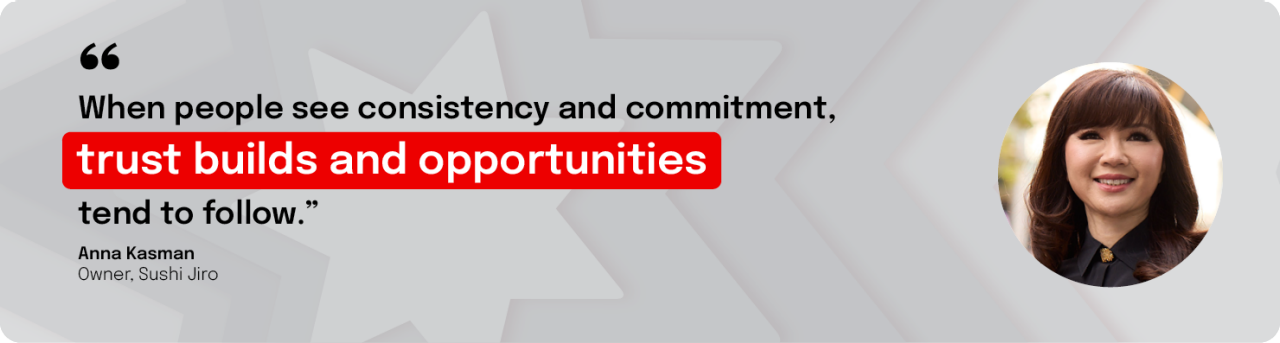
“Back your vision but stay disciplined. Access to capital matters – certainly it gave us the ability to invest in better design, stronger systems and long-term growth – but understanding your numbers and communicating clearly is what makes the difference. When people see consistency and commitment, trust builds and opportunities tend to follow.”
Simone Joliffe, Co-owner, Currajugle Holsteins
Over the years, Simone and her husband have grown from 180-cow sharefarmers to running a 360-cow housed dairy – with plans to add robotic milking in 2026 to allow their cows to milk on their own schedule. Early on, family support was invaluable, stepping in as guarantors when they purchased their first herd.
They soon moved beyond those safety nets, however, using a mix of finance options – including a livestock lease at higher interest rates – to secure farm ownership. “That facility kept us focused and sharp, and after five years, paying it off brought a real sense of achievement,” Simone says.
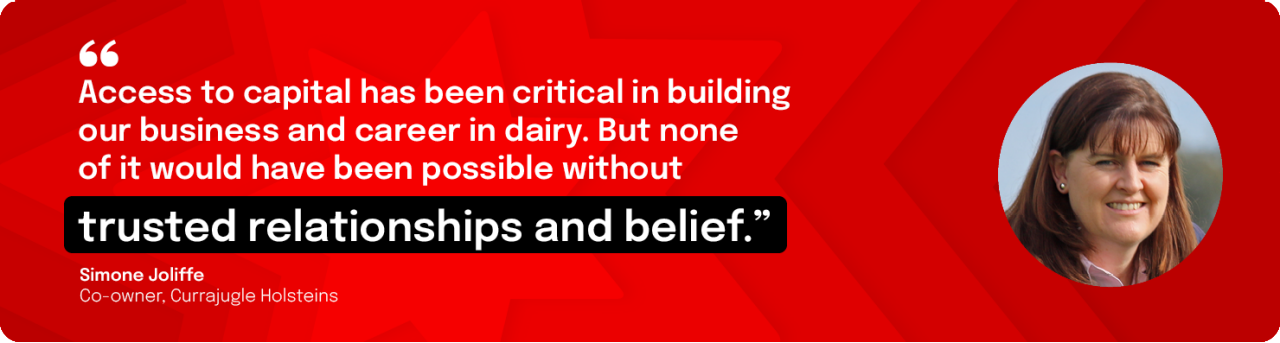
Her advice to others? “Access to capital has been critical in building our business and career in dairy. But none of it would have been possible without trusted relationships and belief – both in ourselves and from others.”
Maria Baker, Founder and Owner, Nobody’s Princess
Nobody’s Princess designs its own snow gear, built on the belief that it should fit women of all body shapes. It seems plenty of us agree. Since 2020, founder and owner Maria Baker has watched her idea grow into a successful business reality.
So, what did it take to bring her vision to life? A good deal of flexibility when it came to capital. "Beyond easing financial pressure, access to capital via a trade finance facility gave us stronger negotiating power with suppliers and freed up much-needed funds to reinvest into marketing and operations," Maria says.
“We’re excited for the future of Nobody’s Princess – we’re planning to expand our warehousing into overseas locations to support increased demand, which marks another step forward in our business journey.”
Julie Rynski, Executive, NAB Business Banking, Metro & Specialised
NAB is very fortunate to know and support many successful women in business. Yet it’s worth asking whether they could do even more – and, if so, what would that take? While many women-led businesses are keen to grow, their ambitions are often mapped over longer timeframes. What, for instance, would need to change to turn a five-year plan into a three-year one?
Women-led businesses are known for careful, disciplined planning, and the data support this. We consistently see robust, well-considered business plans and, importantly, lower default rates. That approach is a clear strength, but it can sometimes slow momentum – often unnecessarily.
For instance, many women-led businesses are reluctant to rely on the family home as collateral. But there are other ways to access capital, including through cash-flow lending, equipment finance and trade facilities. Are they exploring all their options?
Sometimes, it’s simply about having the confidence to be bolder and move faster.
Krissie Jones, NAB Executive Business Direct and Small Business
Access to capital remains one of the most cited barriers for women-led businesses. But practical pathways exist. At NAB, we’ve seen strong progress, with lending to female business customers more than doubling since 2020. The fact is, with the right preparation, women can and do secure funding to grow.
So, what does it take? My advice is to seek support from the outset. Maria Baker, founder of Nobody’s Princess, used trade finance early on to bridge the gap between paying overseas manufacturers and receiving retail revenue – helping her expand internationally. It also helps to leverage trusted advisers like accountants, bookkeepers and mentors within your industry to provide the insights you need and to build networks.
You also need to build a clear business plan with strong financials. Lenders look for clarity, not perfection. Forecasts, cashflow projections and a strong understanding of your customer base make a big difference. But most importantly, remember to back yourself. With the right groundwork and partners, capital becomes a pathway – not a barrier – to growth.
Alli Dolling, Business Banking Executive, NAB Health NSW
As someone working closely with healthcare businesses across GP, dental and specialist practices, my core advice to women-led health businesses seeking capital is to start by building clarity and confidence in your numbers. Lenders want to understand the ‘why’ behind a practice’s growth plans, and a well-articulated strategy makes a meaningful difference.
For example, I recently worked with a female GP practice owner who secured funding to expand to a second location. What set her apart was her preparation – clear data on patient demand, a staffing plan and a sustainable cash‑flow model. Similarly, a women‑led dental group I support strengthened their application by demonstrating how new equipment would improve patient throughput.
Women in healthcare already lead with purpose and deep sector knowledge. When paired with strong financial visibility, the support of advisers and a willingness to advocate for their value, access to capital becomes far more achievable.
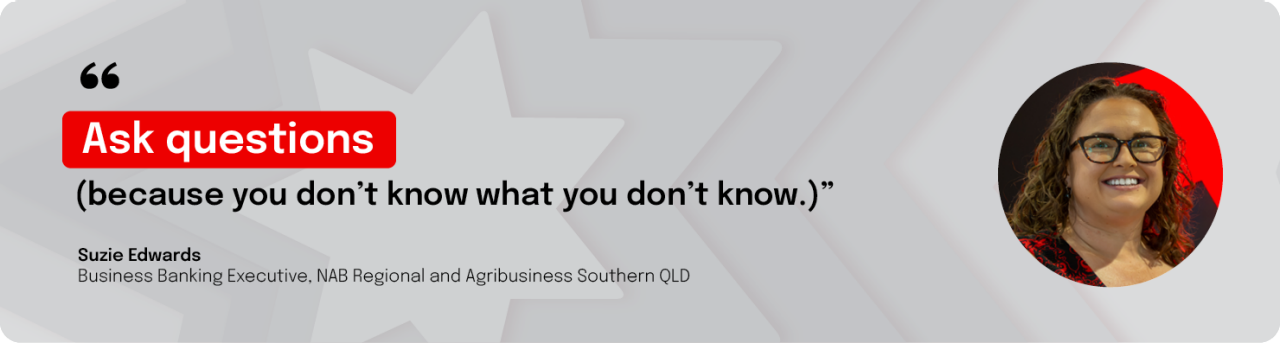
Suzie Edwards, Business Banking Executive, NAB Regional and Agribusiness Southern QLD
For women-led businesses seeking access to capital, preparation and confidence are key. Knowing your numbers and clearly articulating your business story is paramount to know where you’ve come from, where you’re going and how the funding will support your growth.
At the same time, be open to advice. Ask questions (because you don’t know what you don’t know) and explore different funding pathways. It’s not a one size fits all. With the right preparation and partnerships, women-led businesses are well placed to thrive, delivering benefits not just to their own businesses, but to their families, communities and regional economies. Developing relationships with like-minded yet diverse people, no matter their industry, will open doors you never knew existed.
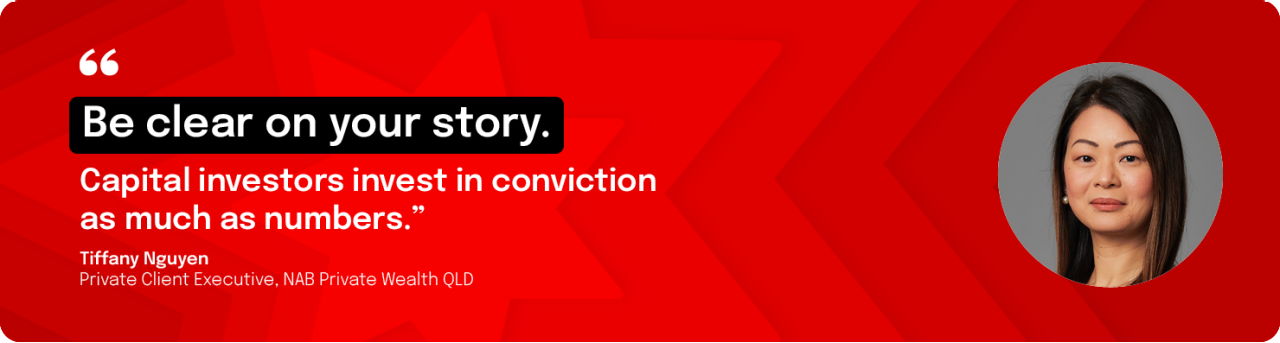
Tiffany Nguyen, Private Client Executive, NAB Private Wealth QLD
Accessing capital is not simply a financial milestone – it’s a strategic one. For women‑led businesses seeking to start or scale, consider three core principles: clarity, credibility and connection.
First, be clear on your story. Capital providers invest in conviction as much as numbers. Articulate what your business does, why it exists, who it serves and how it will grow sustainably. Second, build credibility early. Know your numbers and be prepared to discuss risk as well as opportunity. Finally, invest in relationships, not just transactions. Seek out communities and programs that are support women‑led enterprises. These connections can provide not only funding pathways, but insight and confidence that can be just as valuable as capital itself.
Above all, back yourself and be bold! Women‑led businesses are not a niche – they are a powerful and growing force in the economy.
Kate Bain, Executive, NAB Professional Services, Government, Education & Community, Franchising
Be clear about your growth goals, your appetite for risk and your timeline. Consider your own capacity – and that of your co-owners and the business – to identify and absorb different growth opportunities, whether that’s organic expansion, acquisitions, mergers, or strategic partnerships. Be equally clear on your non-negotiables, including cultural priorities.
Learn about the potential sources of funding for a business at different stages of its lifecycle. When the time is right, engage with bankers with specialised industry knowledge. That ensures the advice – and solutions, such as equity funding structures for partnerships – are tailored to your circumstances.
Finally, network with people in your industry. Shared experiences and trusted referrals are worth their weight in gold.