13 May 2026

13 May 2026
2026 Federal Budget: What it means for Health
On the health side, the Budget was dominated by major NDIS reform that focused on savings, plus spending on aged care, urgent clinics and PBS listings.
Key Points
- Despite the energy shock and RBA tightening cycle, the cyclical starting point for the 2026-27 Budget was positive, with above trend GDP growth and a tight labour market. Relative to MYEFO, the deficits have improved by $45 bn over the forward estimates, as the government has elected to bank a portion of the improved revenue flows.
- The Budget forecasts that the underlying cash balance is likely to remain in deficit for the at least the next decade. The expected deficit for 2026-27 is $31.5bn. The headline cash balance, which accounts for “off balance sheet” expenditure or investment, is forecast to be $64bn in 2026-27, around 2.1% of GDP.
- Reform, restraint and resilience were the three self nominated pillars that were used by the Treasurer to frame the budget. Generally speaking, the Budget addresses all of these.
- Reforms were largely as pre-announced. Negative gearing has been removed except for investment in new builds. The CGT regime will move to an indexation framework, with a minimum 30% CGT tax payable on net gains. However, investors in new builds will have the option of choosing the indexation arrangement or the old 50% CGT discount.
- These reforms remove the incentive to deploy capital into low yielding/high debt investments in property. This is a benefit to broader financial stability, but will likely mean a small decline in house prices and near term upward pressure on rents.
- The government has been relatively restrained on cost of living measures, with the tax offset for working Australians small and not starting until July 2027.
- The government’s economics forecasts are broadly in line with the RBA’s and our own numbers. Growth will slow, inflation will rise and the unemployment rate will drift higher .
- We assess the stance of fiscal policy as neutral for the coming financial year, although this represents a change from expansionary fiscal policy in 2025-26. As such, the change in fiscal settings will better align with the RBA’s monetary policy ambitions.
What has the budget delivered for Health this year
Medicare
- The Government will provide $2.1bn over five years from 2025–26 (and $599.6m per year ongoing) in relation to primary and specialist health care services and to increase access to bulk billing clinics along with an ongoing focus on fraud protection across the health sector
- Funding includes:
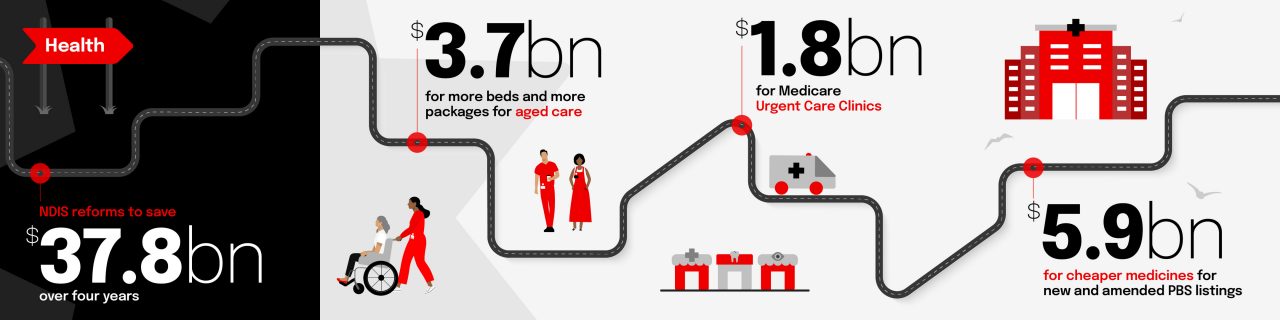
- Medicare Urgent Care Clinics: $1.8bn over five years from 2025–26 to maintain access to bulk-billed urgent care. The Government aims for four in five Australians to be within a 20-minute drive (137 clinics).
- $119.0m to extend the practice incentive program (PIP) from 2026–27 for two years, supporting general practices to deliver continuous quality improvement.
- $54.5m over three years for after-hours and homeless access programs to support at-risk cohorts within Primary Health Networks.
- $47.6m over four years from 2026–27 to increase Radiation oncology grant value and support affordable cancer treatment for concession card holders.
- $25.3m for six full bulk billing clinics across the Central Coast, Newcastle, Lake Macquarie and the Hunter.
- $745.1m over four years from 2026–27 (and $17.6m per year ongoing) for Medicare systems and infrastructure, including My Health Record and expanded information sharing.
Pharmaceutical Benefits Scheme (PBS)
- $5.9bn over five years from for new and amended listings on the Pharmaceutical Benefits Scheme (PBS) and Repatriation Pharmaceutical Benefits Scheme.
- The additions cover treatments for juvenile arthritis, multiple sclerosis, prostate cancer, lymphoma, lung cancer, bladder cancer, cerebral palsy and severe COVID-19.
- Changes to cystic fibrosis medication listings “will save some Australians around $250,000 a year”.
Pharmacy
- The Government is also investing $449.3m to list the respiratory syncytial virus (RSV) vaccine Arexvy® for eligible older Australians on the National Immunisation Program to protect against respiratory infection caused by RSV.
- Families and children will have better access to vaccinations as the National Immunisation Program Vaccination in Pharmacy (NIPVIP) expands and an enhanced childhood immunisation campaign rolls out. Children under 5 will be able to access vaccinations in pharmacies, and families will receive SMS reminders and targeted information to support higher vaccination rates.
Women’s Health
- The 2026-27 Budget largely builds on the Government’s $792.9m women’s health package announced in 2025-26, with a focus on targeted extensions and access reforms rather than new standalone funding. Measures are primarily delivered through MBS, PBS and existing program settings.
- Key measures include:
- A National Menopause Awareness Campaign, supported by training for health professionals to improve diagnosis, workforce participation and care quality.
- Expanded access to contraception, including new MBS items enabling midwives to provide and bulk bill long‑acting reversible contraception (LARCs).
- A pharmacist‑led trial enabling PBS‑concessional access to hormonal contraception and treatment of uncomplicated UTIs.
- Establishment of a Ministerial Expert Panel on Women’s Health to address systemic gaps in prevention, diagnosis and treatment.
- Expanded programs include broader scope for Endometriosis and Pelvic Pain Clinics, and continued investment in culturally safe maternity care, including Birthing on Country models.
Mental Health
- $283.2m over four years from 2025–26 will be invested in mental health; $277.5m will be spent this year to 30 June 2027 to extend the National Mental Health and Suicide Prevention Agreement, and includes:
- $206.8m for existing mental health and suicide prevention activities under the Agreement
- $70.4m to extend terminating mental health and suicide prevention activities under bilateral arrangements, including support for Victorians, suicide bereavement, perinatal, postnatal, and eating disorders.
- Thriving Kids Program - $99.5 million over five years from 2026–27 to empower parents, carers and kin with the skills to support children with developmental concerns or autism through Mental Health in Primary Schools and the Positive Partnerships Program, and through a National Digital Child Health Record in My Health Record.
Aged Care
- The Budget’s aged care package is now framed as a $3.7bn investment to deliver “more beds, more packages and better care for older Australians”, with a strong emphasis on expanding residential supply and improving viability for providers.
- $1.7bn to incentivise construction of up to 5,000 residential aged care beds per year, with an explicit equity focus for those who are less well off.
- $606.5m to introduce new capital subsidies for providers who build or expand residential accommodation, and to deliver up to 20 additional Specialist Dementia Care units plus expand the Hospital to Aged Care Dementia Support program from 11 to 20 locations nationally.
- This includes $348.4m over four years (and a further $2.7bn over the subsequent six years) to provide long‑dated, per‑resident capital support of $30 per supported resident per day for newly constructed homes (up to 25 years) and $15 per supported resident per day for significantly expanded homes (up to 15 years), improving project feasibility and long‑term cashflow certainty for providers.
- $1.1bn provisioned for future spending to increase and restructure the Accommodation Supplement, including an additional payment for homes with more than 60% low-means residents.
- $565.1m to improve sector quality, safety and viability, building on earlier reforms and regulatory oversight.
Home Care
- The Government announced a total of $1.4bn over four years from 2026–27 (and $377.3m per year ongoing) to improve affordability and access to home care supports, including:
- $1.0bn over four years to strengthen the Support at Home program, reclassifying core ‘personal care’ services (e.g. showing) as clinical care so they are fully funded with no co-contributions for older Australians.
- $389.8m over four years to implement and refine the Support at Home program, including to assessments, hardship applications and the end‑of‑life pathway, and to bring forward availability of program places.
Hospitals
- The Budget commits an additional $25bn in Commonwealth funding for public hospitals, taking total hospital funding to ~$220bn over five years from 2026-27.
- Funding is framed as a reset of hospital funding adequacy, outpacing the previous framework to better align with demand and cost growth - improving system capacity and emergency department flow, and in turn providing indirect but meaningful benefits to ambulance services by reducing ramping and demand pressure.
- Of the total, $24.4bn over five years is delivered through higher NHRA base funding linked to hospital activity, with over $600m in additional targeted investments.
- Targeted measures include interim support for small jurisdictions ($221m in 2026–27 to the ACT, NT and Tasmania), $200m (matched by states and territories) to improve hospital outcomes for Aboriginal and Torres Strait Islander people, support for cross‑border services, digital health implementation, and NHRA system governance and data‑sharing reforms.
NDIS
- As was expected, the Federal Government announced significant reforms to the National Disability Insurance Scheme (NDIS) aimed at restoring the program to its original intent and reducing NDIS spending.
- These reforms centre around four key pillars:
- Clear eligibility requirements – designing a standardised, evidence-based assessment of functional capacity to determine if someone can access the scheme. They will spend $19.2m over four years to establish a Technical Advisory Group and ensure Disability Representative Organisations can facilitate community consultation on these reforms.
- Slow the rapid cost increases – to address the issue of unscheduled reassessments driving spending growth, reforms will focus on tightening criteria around plan reassessments. Budgets for social, civic and community participation and capacity building daily activities will be reset, and New Framework Planning will deliver more equitable, consistent and sustainable participant plans from April 2027.
- Fighting fraud – the government will increase oversight, investing $821.2m over four years to expand the mandatory registration of providers, increase oversight of payments, continue the Fraud Fusion Taskforce and strengthen the NDIA’s investigation and enforcement capabilities.
- Delivering quality services and support to participants – to ensure quality and fit for purpose services and supports, the Government will commission plan management and support coordination, and consult on home and living supports for Supported Independent Living participants so they receive the best supports and to address provider viability challenges.
- The government will provide $1.7bn over five years to support participants and improve the NDIS, with funding including:
- $436m in 2026-27 for the NDIA to support NDIS participants
- $385.5m over five years for a new enrolment and digital payment system to reduce fraud and non-compliant payments
- $280.1m over 5 years to continue the Fraud Fusion Taskforce
- $270.1m in 2026-27 to prepare for new framework planning from 1 April 2027
- $182.6m over 4 years to introduce mandatory registration of high-risk NDIS providers, partially offset by $27.1m over three years from cost recovery arrangements.
- Further, the government are investing $200m over three years to establish an Inclusive Communities Fund to support community organisations to provide group based social support to NDIS participants.
- The budget also provides $2bn for the Thriving Kids program, as part of a broader $5bn Foundational Supports commitment to be matched by the states.
- The reforms are expected to reduce growth in NDIS spending by $37.8bn over 4 years. The NDIS will continue to grow annually, and remain the second largest social program.
Dental
- $431.0m over four years (and $107.8m per year ongoing) to extend the Federation Funding Agreement for Public Dental Services for Adults. This is targeting eligible concession holders.
- Access to the Child Dental Benefits Schedule to state and territory dental services has been extended from 2026–27 providing services up to $1000 for eligible children aged 2-17.
Private Health Insurance
- The Federal Government is removing discounts for Australians over 65 from 1 April 2027, aligning the Private Health Insurance rebate entitlements across age groups. Removing age as a determining factor for the PHI rebate will save the government $3bn over four years from 2026-27, and $1bn per year thereafter.